
Searching Le Sueur County Criminal Dockets
The statewide tool for a Le Sueur County criminal docket is MCRO Case Search. Pick Case Number when you have a court file number. Running a name search instead? Choose the criminal category and set the court location to the option styled LeSueur. MCRO also takes a citation number for citation-based cases. It offers an attorney search where that fits. Spell the name exactly at first. If nothing comes back, try Sounds Like or a trailing wildcard to widen the net.
Once the right case appears, open Case Details and the Register of Actions. That ROA is Minnesota's working docket record. Check the displayed court and category before assuming a result is your case, though. MCRO costs nothing for remotely available public records. It is not a certified record.
- Open MCRO and select Case Search.
- Enter the full court file number, or select Name and use the criminal category.
- Choose LeSueur if a county filter is needed.
- Open Case Details and read the public Register of Actions.
- Use Court Administration for a certified copy or a public record not available remotely.
Le Sueur County Criminal Docket Name Limits
MCRO itself warns about this. A pending criminal matter may not show up in a defendant-name search. That gap does not mean no Le Sueur County criminal docket exists. Use a verified court file number when you can. Ask the adult criminal division how to find a public case. Or try the courthouse terminal when the record is open to local access. Do not guess at a local case-number pattern; the county publishes no safe format guide.
When you copy a number, take it exactly from a court notice, calendar entry, or current MCRO result. Keep the leading letters, digits, and year parts. A citation number is not automatically a court file number either. Traffic citation rather than adult criminal complaint? Follow the separate Traffic Tickets route and the court notice instead.
The official MCRO interface lays out every public criminal search route.
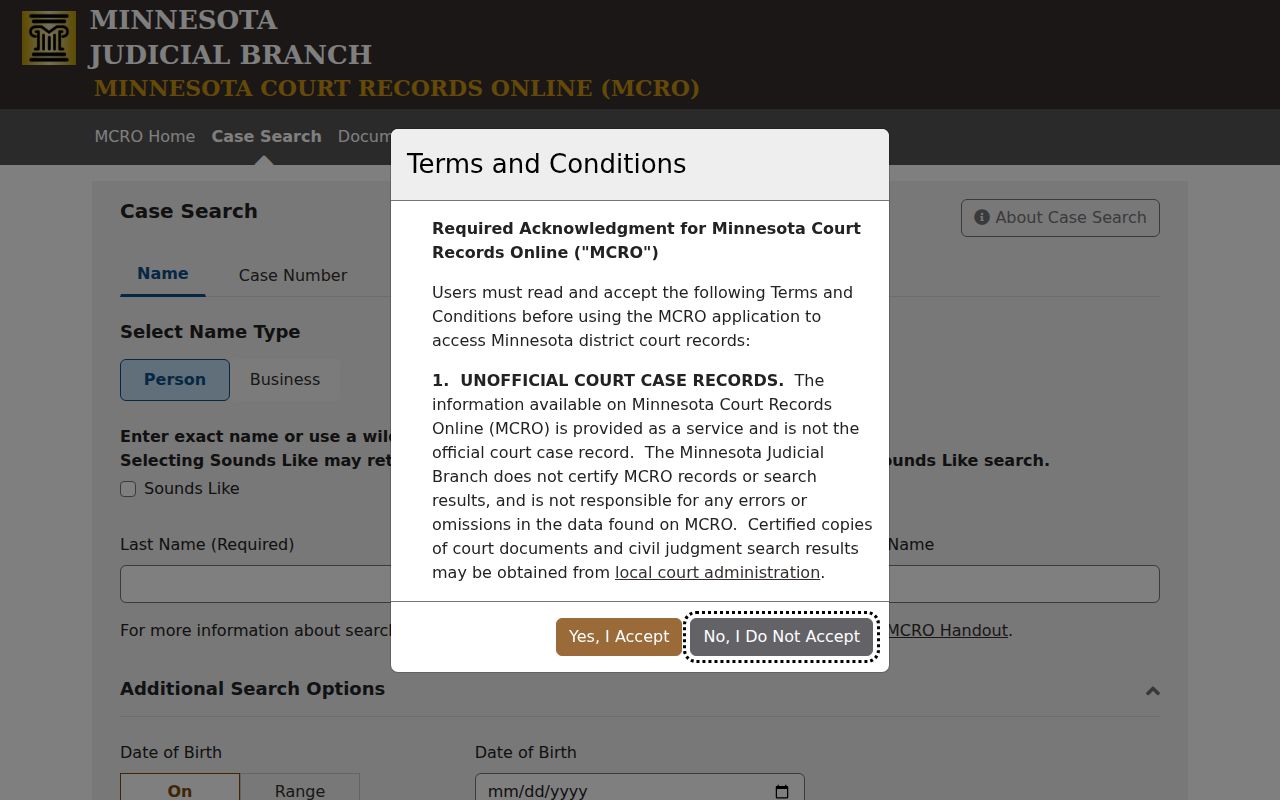
The official page highlights the public search route. Even so, a full court file number remains the strongest key.
Inside a Le Sueur County Criminal Docket
Open a Le Sueur County criminal docket and you may see the court and county, the court file number, category, filing date, case status, party roles, judicial officer, and location. The Register of Actions goes further, listing complaint and filing events, hearings, motions, orders, public document index numbers, disposition entries, sentencing details, and whatever financial fields the access rules permit. Remember what the record is. It is an event history, not a judgment about anyone.
Read some fields with care. A charge is an allegation, nothing more. A listed hearing is only a scheduled event, not a transcript or result. A financial entry may not reflect a current balance. Public access can also pull documents, exhibits, identifiers, or protected fields from view. Check the displayed date and source. When you need an official or complete answer, contact the local court.
| Court file number | The local case identifier used by MCRO and Document Search. |
|---|---|
| Case status | A system field that does not automatically state the final outcome. |
| Register of Actions | Chronological filings, hearings, motions, orders, and other public events. |
| Document index | Public document references, subject to document date and access limits. |
| Disposition and sentence | Recorded entries that should be read from the actual case record. |
Le Sueur County Criminal Docket Documents
Many major and minor criminal documents sit in MCRO for remote viewing. These are documents filed on or after July 1, 2015, subject to Rule 8, Rule 4, case type, and any court restriction. Older images may demand a courthouse terminal or a local copy request. Finding the case in Case Search does not finish the job, either. A document can stay unavailable remotely. Its document family, filing date, or access status differs from the public Register of Actions.
MCRO Document Search runs on the court file number. It does not promise every attachment or exhibit. Need a plain, certified, or exemplified copy? Use the Judicial Branch copy process through the county where the case was filed. The statewide form lets you describe the document by name, date or index number. It also covers copy type and delivery method.
The official Document Search source shows the case-number route for a public criminal document.
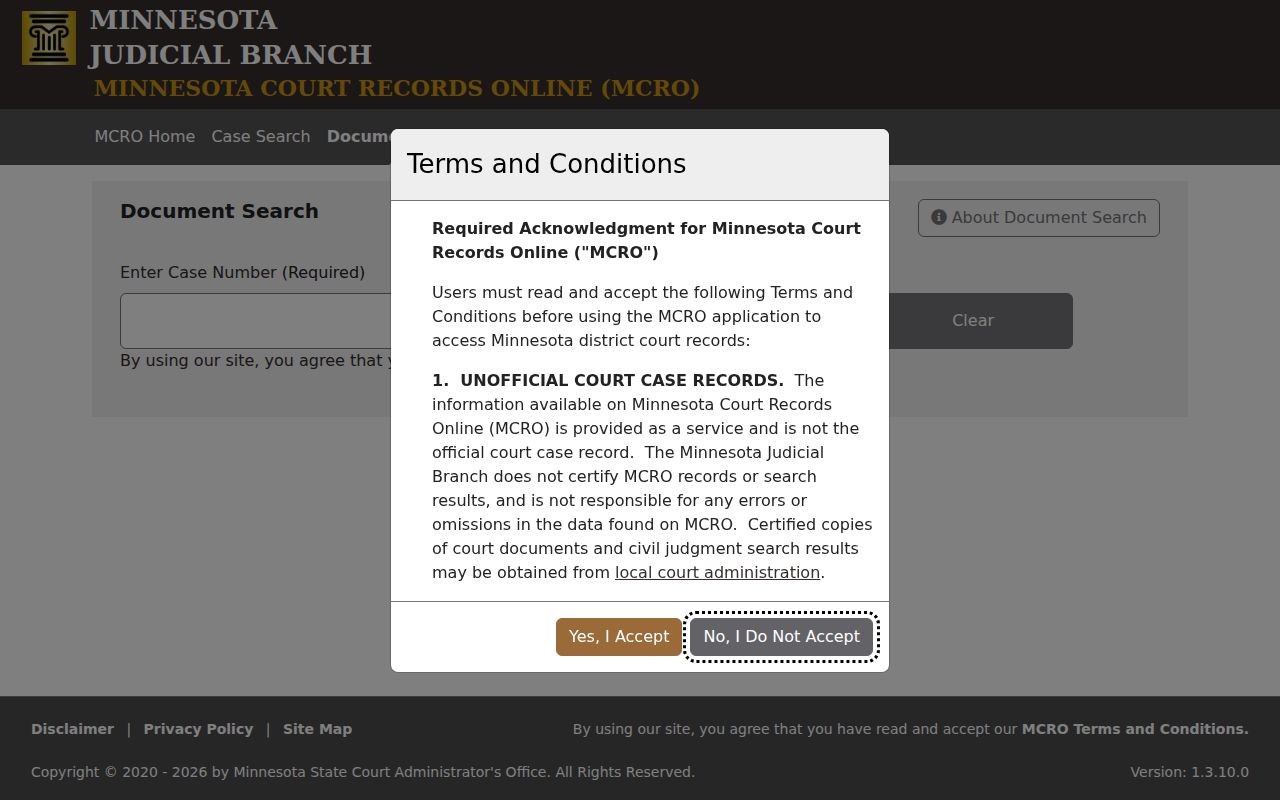
The precise court file number is what makes a document search work.
How a Criminal Case Moves
A Le Sueur County criminal docket records case movement as the court processes the matter. A typical progression is Filing → Arraignment → Pretrial → Plea or Trial → Disposition → Sentencing. Not every case uses every stage, and an event can be continued, rescheduled, or restricted. The Register of Actions identifies the actual events for the specific case rather than a fixed promise about how a case will end.
The local Daily Public Court Calendar and MCRO Hearing Search are separate tools. Use either one for a future hearing. The daily PDF can shift during the business day. The Register of Actions, by contrast, holds the fuller case history. A calendar omission does not prove a cancellation, especially with confidential or nonremotely accessible cases. To confirm an apparent change, call Court Administration at 507-357-8260.
Le Sueur County Criminal Docket Access Chain
An MCRO lookup can leave the question open. If so, work down the Le Sueur County criminal docket access chain in order. Start with MCRO Case Search. Then try the Minnesota public-access terminal at the courthouse. From there, call the adult criminal division. Try Court Administration by phone or at the counter. Finish with a statewide copy form or access request when the record rules demand one. Every Minnesota district courthouse keeps a public terminal. Statewide guidance calls it the most complete electronic route into District Court records. The Minnesota public-access terminal guidance spells out that in-person option.
The adult criminal line is 507-357-8259. For general help, Court Administration answers at 507-357-8260. A mail request should name the county and the court file number. Add whatever identifying information you have. Include the document wanted, the copy type, a delivery address, and payment if the office requires it. Fax and email only carry plain, nonconfidential requests. Local staff must have already agreed to accept them.
Courts That Hold Criminal Dockets
One court holds the local adult criminal docket. That is Minnesota District Court, Le Sueur County District Court. The Le Sueur court-divisions page shows criminal and traffic work sitting inside that District Court structure. It sits next to civil, family, juvenile, probate, mental-health, guardianship, and treatment-court divisions. Traffic and petty matters are close cousins. Search them under their own docket category and court notices. Do not assume they behave like adult criminal cases.
Treatment Court is a District Court program, not a standalone public county court. A search for its cases begins in MCRO or at a public terminal. Participant, treatment, and service details may be restricted, though. Police departments, jails, and the county attorney do not keep the District Court Register of Actions. An agency may hold a separate public record of its own. The official divisions source lays out the full local structure.
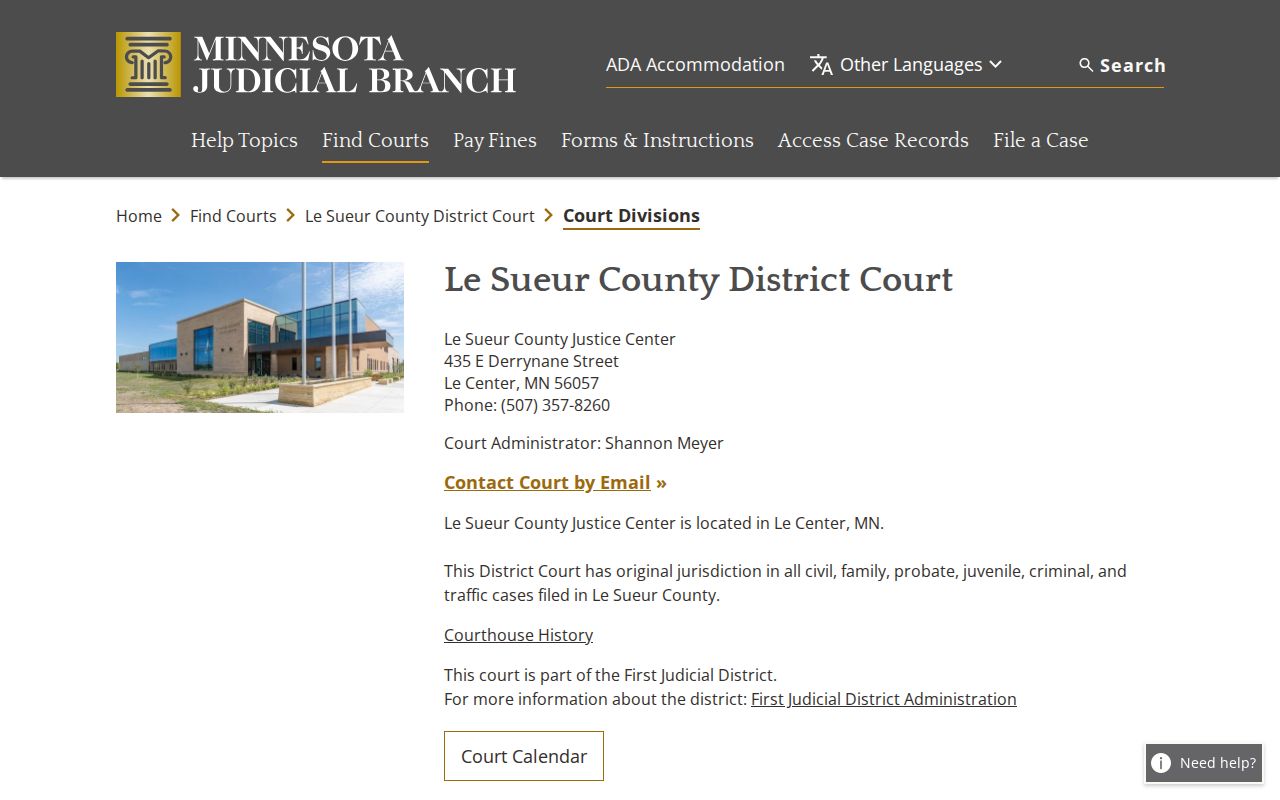
The divisions listing ties the criminal docket to the court that keeps the local case file and calendar.
Le Sueur County Criminal Docket Contacts
Call the adult criminal division at 507-357-8259. Court Administration's general line, 507-357-8260, handles calendar, record-location, certification, courthouse-access, and local-procedure questions. The Le Sueur County District Court directory lists the Justice Center as the current court-service location at 435 East Derrynane Street, Suite 2400, Le Center. Official pages disagree on 56057 versus 56058. Confirm the ZIP code before you mail anything or drive over.
Juvenile and delinquency questions go to 507-357-8256, but juvenile access carries tighter restrictions. For Court Payment Center matters, the court lists 651-281-3219 or 800-657-3611. A docket financial entry is not a live balance. Confirm payment handling with the proper office.
Le Sueur County Court Administration
Justice Center, 435 East Derrynane Street, Suite 2400
Le Center, MN 56057 or 56058
Adult criminal: 507-357-8259
Sealed Dockets and Public Access
Public access to a Le Sueur County criminal docket stops at certain lines. Rule 4 governs sealed records. The rule also covers court-services material, judicial work product, protected domestic-abuse and harassment information, juvenile material, and other restrictions. Rule 8 then limits what protected identifiers and certain document categories can show remotely. So a case may carry a public Register of Actions. Its individual documents can still stay offline.
Records involving juveniles, CHIPS, civil commitment, domestic abuse, harassment, and similar matters each need their own rule check. A result that will not load proves nothing. Never assume an unavailable case was dismissed or never filed. Court Administration can name the correct request-for-access process. Hold off ordering a sealed or confidential record until the required authorization is in hand.
Access boundary: Rule 4 identifies restricted Judicial Branch records, while Rule 8 governs public inspection, copying, remote access, and redaction.
The official Rule 4 source sets out the protection rules that can narrow a criminal docket result.
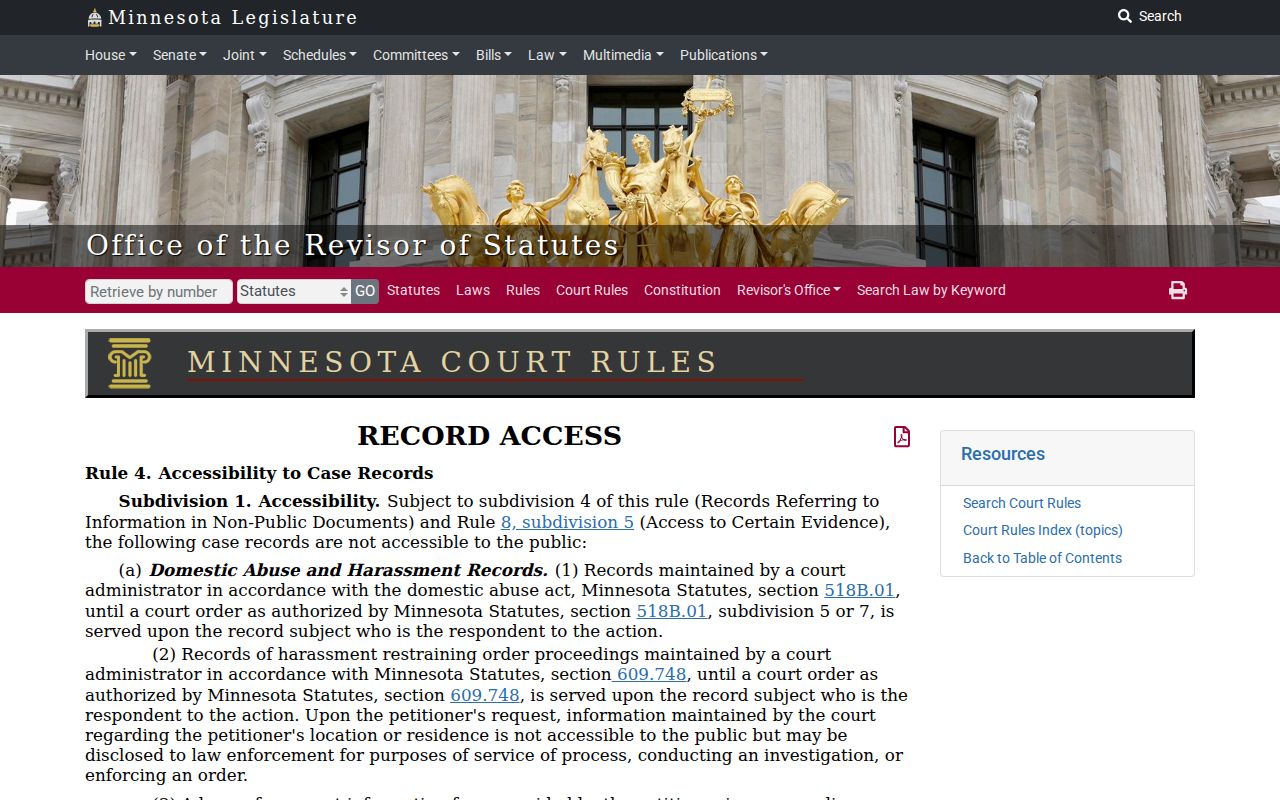
The rule text drives home one point. A remote search result has different limits than a certified or authorized court record.
Le Sueur County Criminal Docket Filing Access
Minnesota eFile and eServe, called eFS, is the filing and service system for attorneys, government agencies, guardians ad litem, and self-represented users who choose it. Its job is not docket reading. An eFS filing can land in the court file. Public viewing still depends on MCRO, a public terminal, Rule 8, and the local record custodian.
Criminal complaints, citations, tab charges, and juvenile-delinquency petitions or citations are excluded from the eFS path under current Judicial Branch guidance. That carve-out is one reason for caution. A public user should not assume every criminal event passed through the same system. Turn to MCRO for public lookup. Bring filing or document-access questions to Court Administration.